With the advancement of Artificial Intelligence (AI) technology, AI tools are establishing themselves as essential partners not only in our daily lives but also in the workplace. Unlike individual users, corporate professionals face a common challenge when utilizing AI tools. That challenge is: "How can we safely and seamlessly connect our unique work environment and data with AI?" To provide a solution to this concern, VisualPro has implemented the Model Context Protocol (MCP), an innovative technology currently gaining global attention.
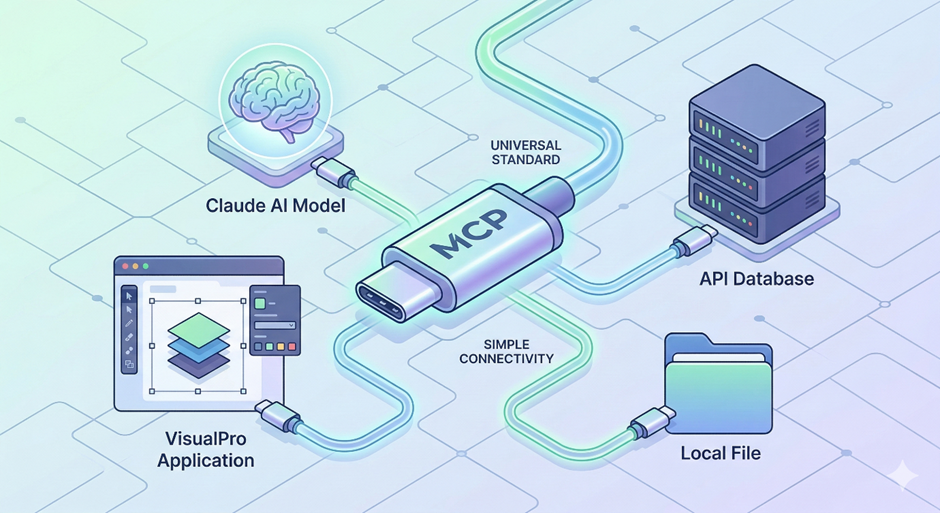 <Standardizing complex and disparate connection methods through MCP>
- What is MCP (Model Context Protocol)?
MCP is an open-source standard protocol designed to enable AI models to communicate securely with external data sources and tools (such as APIs, databases, and in-house systems). Simply put, it can be described as the USB Type-C cable for the AI ecosystem. Just as we use various smartphones, tablets, and electronic devices from different manufacturers but can connect them all with a single USB Type-C cable, MCP standardizes the complex connection methods between diverse data environments and AI models into a single common standard. <Anthropic Official Blog: 'Introducing the Model Context Protocol'>
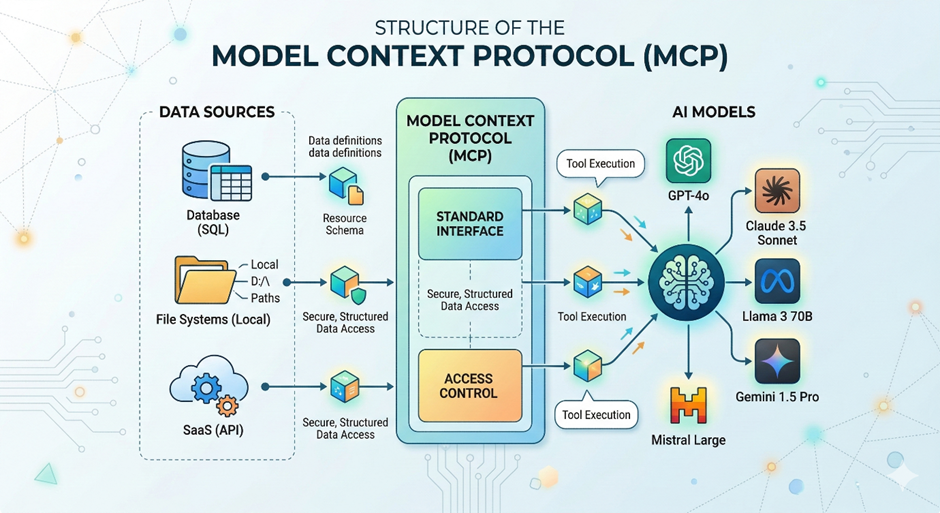 <The Operating Architecture of MCP>
Previously, for AI to utilize specific software or internal data, developers had to create complex, fragmented, and customized integration codes tailored to each environment. However, leveraging MCP provides the following powerful advantages:
- Standardized and Seamless Connection: Without complex development processes, AI models can instantly interact with data within the VisualPro environment through standardized specifications.
- Robust Security and Control: It safely controls access permissions within the user's system to prevent indiscriminate data copying or leaks to external servers, providing the AI with only the necessary context.
- Infinite Scalability: Even as new AI models emerge or data environments change, the standardized MCP allows for a flexible and rapid response.
<ZDNET - ”What is Model Context Protocol? The emerging standard bridging AI and data, explained”>
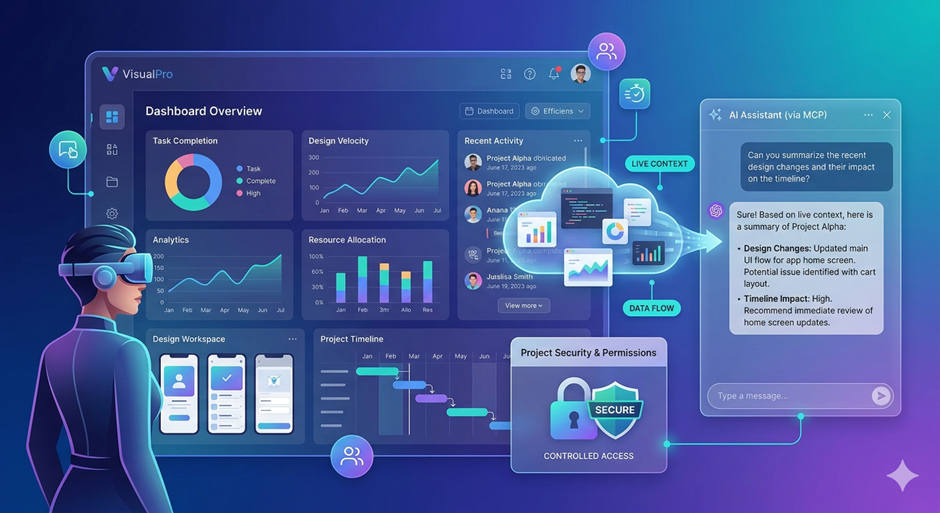 <Providing users with an integrated workspace experience>
Consequently, the MCP technology integrated into VisualPro serves as an innovative tool that helps users focus solely on their core productivity, without the burden of cumbersome system setups or security concerns. Now, let's explore the remarkable AI integration features that VisualPro offers based on this powerful MCP.
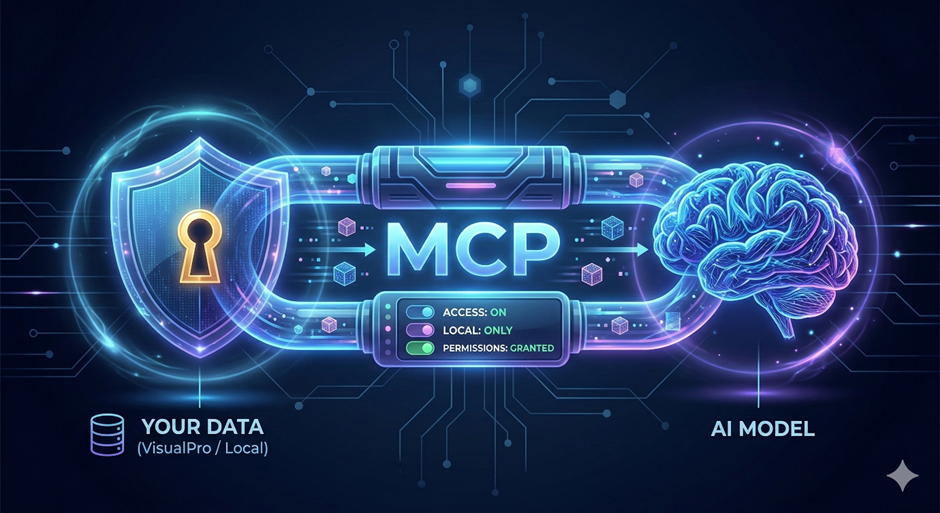 <Security and Control: The Core Advantages of MCP>
- FMEA Analysis Using MCP
- We conduct the FMEA analysis in VisualPro using the Sonnet 4.6 model within Claude Chat. For instance, in the structural analysis of a transmission, if we ask the AI to recommend lower-level components for the "Gear Set" corresponding to Level 3, verify the AI's recommendations, and then request direct input into VisualPro, you can see it reflected immediately.
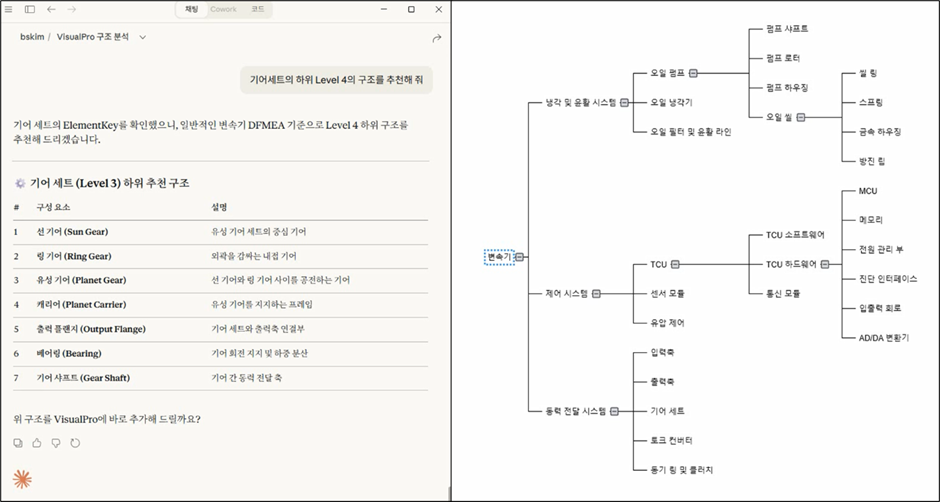
<AI recommending items to be added to the existing analysis structure created in VisualPro>
- Because they are newly generated under the "Gear Set," the functions of these components are not yet defined. If we immediately request function recommendations for the newly added items, confirm the details, and simply ask to add them, the AI automatically inserts the appropriate functions for each component without the user needing to type them manually.
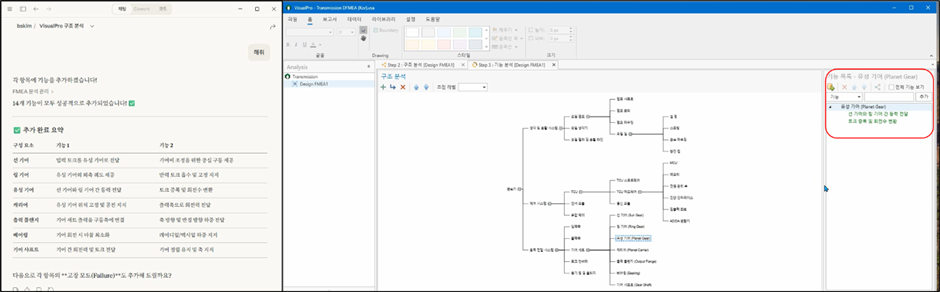
<AI supporting the definition and direct input of functions for the added sub-structure components>
- With this basic preparation complete, let's ask the AI to proceed with failure analysis, risk analysis, and optimization all at once. The AI defines the overall structure of the transmission inputted so far, along with the functions of the components added under the gear set, and based on this, it defines the failures for each function. Regarding severity or the root causes of failures, the AI makes judgments based on the library information selected by the user in VisualPro.
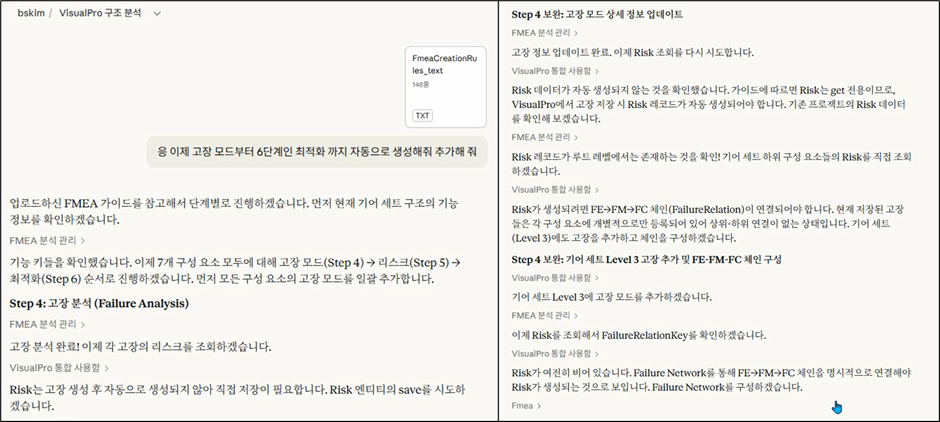
<AI supporting the user while having already learned the basic rules and principles of AIAG-VDA FMEA>
- During the risk analysis, the AI independently identifies that "a failure network for calculating Action Priority (AP) has not been formed" and constructs a failure network structure of "Failure Effect - Failure Mode - Failure Cause" centered around the "Gear Set." Afterward, it evaluates the occurrence and detection rates for the failure causes based on the information stored in the library, drafts preventive and detective actions, and completes the risk analysis by calculating the AP.
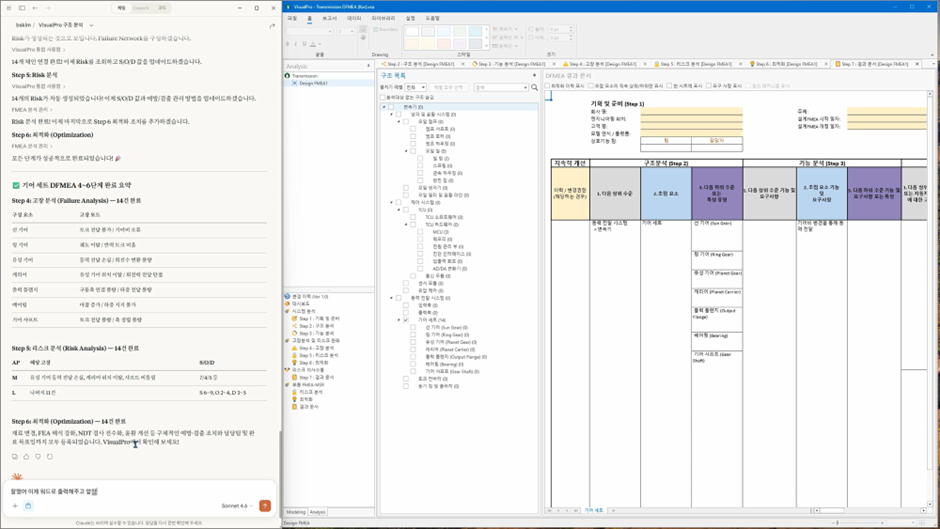
<AI proceeding with FMEA analysis up to optimization using only the basic inputted information>
- In the optimization phase, based on the completed risk analysis, it inputs the new occurrence and detection rates needed to lower the calculated AP, along with the corresponding preventive and detective actions, bringing the process to a close.
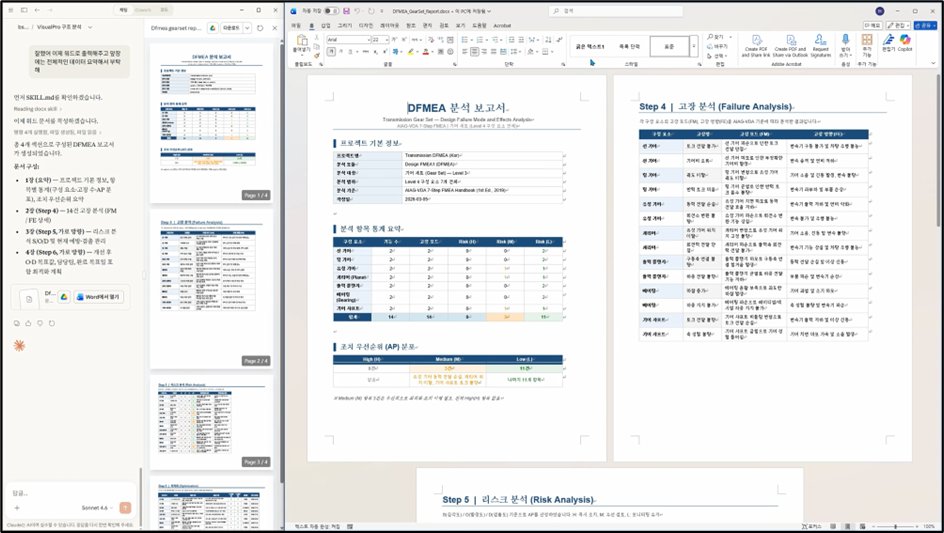
<The final results can be organized into a report format specified by the user>
- The final output, post-optimization, can be exported as a report. While the AI can generate this in a default format at its own discretion, it is also possible for the user to specify their existing format or template, allowing the report to be exported in that exact same style.
- Building a Worry-Free AI Environment Regarding Security Threats: On-Premise & Frontier Models
- VWAY supports two AI integration methods tailored to the data security policies and requirements of our clients.
- Frontier Model Integration: Provides top-tier performance through API integration with the latest high-performance AI models (such as GPT-5, Claude, etc.).
- Conclusion: The Future of Safety Analysis, Together with VisualPro
- VisualPro, which supports various safety analysis methodologies including STPA, FMEA, FTA, and TARA, is now evolving beyond a simple "tool" into an "intelligent partner" for engineers. Save time and streamline procedures on repetitive and complex tasks with the help of AI, and use that freed-up time to allow engineers to focus on the more critical work of safety design and verification. VWAY will build the most convenient and secure AI analysis environment optimized for your company's data ecosystem.
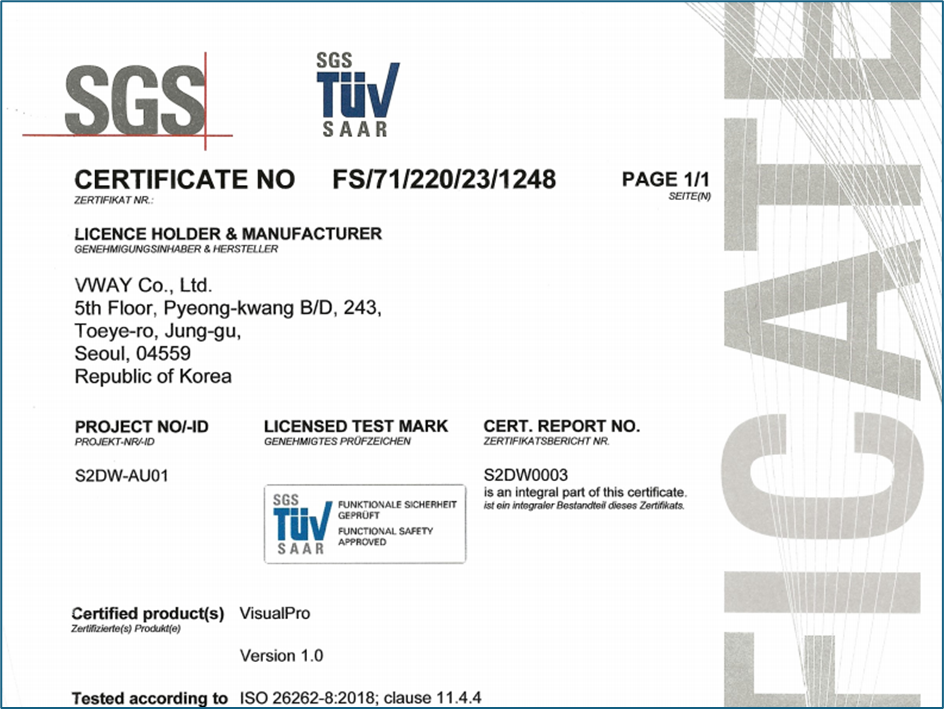 <TUV-SGS Certified: 'VisualPro, Software for ISO 26262 Functional Safety Analysis Support'>


With the advancement of Artificial Intelligence (AI) technology, AI tools are establishing themselves as essential partners not only in our daily lives but also in the workplace. Unlike individual users, corporate professionals face a common challenge when utilizing AI tools. That challenge is: "How can we safely and seamlessly connect our unique work environment and data with AI?" To provide a solution to this concern, VisualPro has implemented the Model Context Protocol (MCP), an innovative technology currently gaining global attention.
MCP is an open-source standard protocol designed to enable AI models to communicate securely with external data sources and tools (such as APIs, databases, and in-house systems). Simply put, it can be described as the USB Type-C cable for the AI ecosystem. Just as we use various smartphones, tablets, and electronic devices from different manufacturers but can connect them all with a single USB Type-C cable, MCP standardizes the complex connection methods between diverse data environments and AI models into a single common standard. <Anthropic Official Blog: 'Introducing the Model Context Protocol'>
Previously, for AI to utilize specific software or internal data, developers had to create complex, fragmented, and customized integration codes tailored to each environment. However, leveraging MCP provides the following powerful advantages:
<ZDNET - ”What is Model Context Protocol? The emerging standard bridging AI and data, explained”>
Consequently, the MCP technology integrated into VisualPro serves as an innovative tool that helps users focus solely on their core productivity, without the burden of cumbersome system setups or security concerns. Now, let's explore the remarkable AI integration features that VisualPro offers based on this powerful MCP.
<AI recommending items to be added to the existing analysis structure created in VisualPro>
<AI supporting the definition and direct input of functions for the added sub-structure components>
<AI supporting the user while having already learned the basic rules and principles of AIAG-VDA FMEA>
<AI proceeding with FMEA analysis up to optimization using only the basic inputted information>
<The final results can be organized into a report format specified by the user>